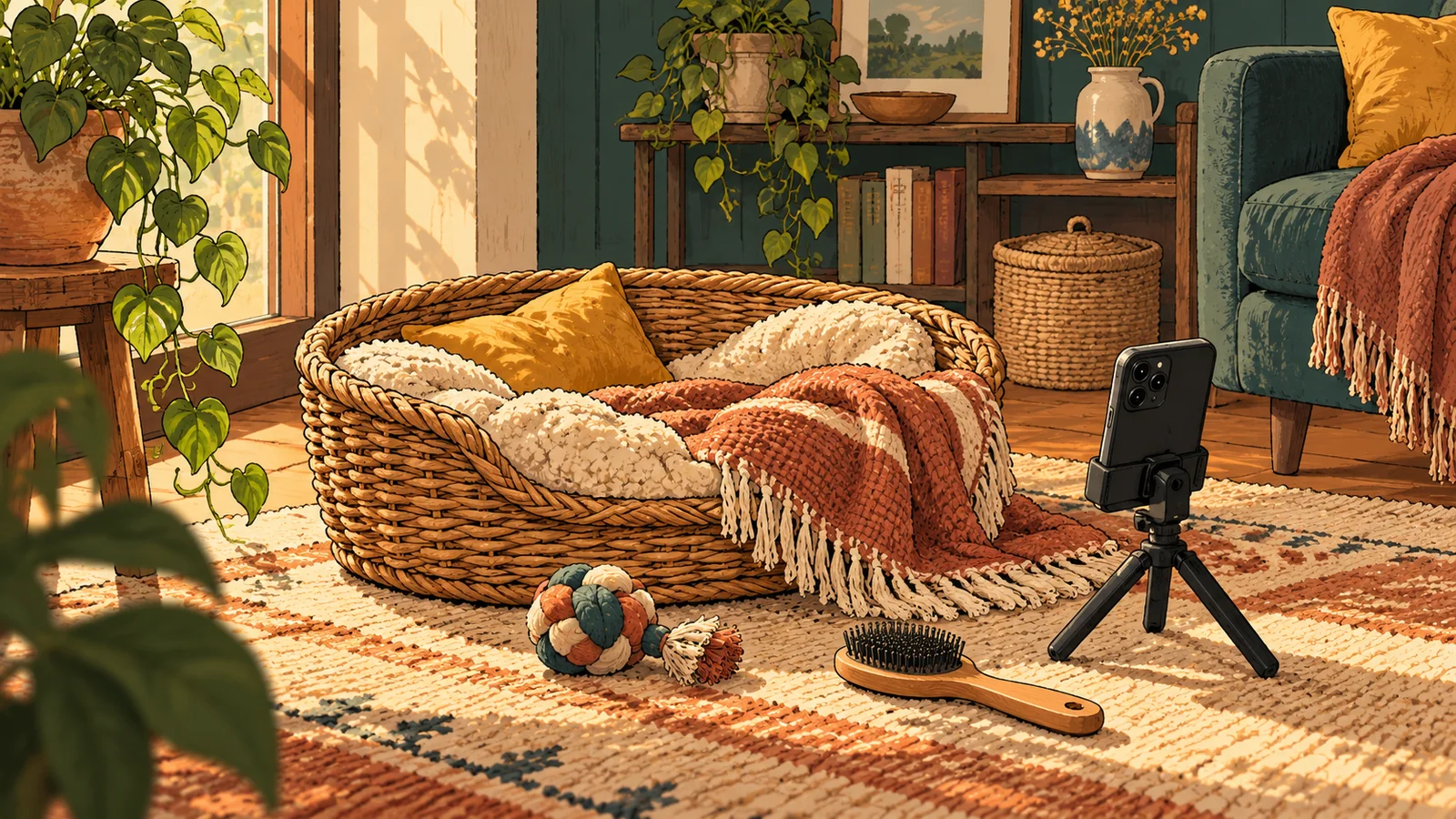
Pet videos do not need a commanded performance, manufactured surprise, or human-style voiceover to have a story. A camera can follow ordinary choices: where an animal rests, what it notices on a familiar walk, how a habitat is maintained, or how a routine changes across a season. The creative task is to observe well and edit honestly.
The welfare rule comes first: the animal can leave. Do not block an exit, withhold food or water, wake a sleeping animal, provoke fear, introduce an unsafe object, repeat a stressful interaction, or stage a rescue. The camera records suitable everyday activity; it never justifies creating distress. Species, individuals, health conditions, and body-language signals differ, so ask a veterinarian or qualified behaviour professional when anything is uncertain.
This guide offers thirteen repeatable formats rather than stunts. The animal’s normal care schedule remains in charge, and every idea has an immediate stop gate.
Set a welfare-first filming protocol
Choose a familiar, uncluttered area with a clear retreat route. Secure lights and stands, remove loose batteries and cables, turn off hot or noisy equipment, and keep doors, windows, balconies, roads, water, toxic plants, fragile objects, and other animals under the responsible adult’s control. Avoid flash and unfamiliar sounds unless a qualified professional has confirmed the setup is appropriate for that individual.
Assign one person to watch the animal rather than the monitor. For dogs, RSPCA guidance identifies signals such as a lowered posture, tucked tail, ears back, yawning, lip licking, gaze avoidance, stiffness, or showing teeth as possible indicators of worry or a demand for space. For cats, crouching, hiding, a tense body, flattened ears, dilated pupils, or changed eating and toileting can be warning signs. These lists are context clues, not remote diagnosis. Stop, create distance, and seek professional advice if behaviour changes or concern persists.
Film short observational windows. Never keep rolling because the first take was not expressive enough. Let the pet approach equipment voluntarily, and accept that “nothing happened” may be the correct outcome.
1. The favourite-place portrait
Show three places the animal chooses to rest during a normal day. Use a fixed wide shot, a quiet detail, and a note about time and conditions. The story is comparison: sun versus shade, elevated versus enclosed, busy room versus quiet corner.
Do not move the animal into a location or interpret preference from one clip. Phrase conclusions as observations—“Milo used this mat on four recorded mornings”—rather than claims about personality or health. Stop if the camera changes the choice.
2. A routine from the animal’s height
Document a familiar route to a bed, feeding area, garden, perch, or habitat door from a low camera position. Protect the camera with a stable mount outside the path; do not attach equipment to the animal unless it is designed, fitted, and accepted for that animal under appropriate guidance.
Edit around transitions: pause at the doorway, turn at the chair, wait by the bowl. The viewer learns the geography without a trick. Stop if the route becomes obstructed or the pet starts investigating cables or supports.
3. The sound map
Record safe, ordinary sounds around the pet: paws on two surfaces, a cage latch operated during normal care, drinking, bedding, purring, or a collar tag where appropriate. Capture each sound without placing a microphone close enough to touch, alarm, or restrict the animal.
Build the video as a labelled soundscape. Preserve natural timing instead of exaggerating every sound with effects. Stop for alert, avoidance, startle, or repeated attention to the microphone.
4. The sniffing walk diary
On a normal, lawful walk, record a few places where a dog chooses to pause. Keep the handler attentive to traffic, other animals, people, temperature, surface hazards, and local leash rules; a shot is never more important than control and awareness.
The edit can map “grass edge,” “tree,” and “gate” without pretending to know what each scent means. Avoid filming private property or identifiable bystanders without permission. Stop for tension, fear, conflict, fatigue, heat risk, or any request from another person.
5. Habitat care before and after
Document routine cleaning or replenishment for a fish, bird, reptile, rabbit, or other companion animal only according to its established care plan. The transformation is the habitat, not forced interaction. Film supplies before the animal is disturbed, then capture the completed environment after normal access is restored.
Do not publish species-care instruction you cannot substantiate, and do not speed up, delay, or alter necessary care for production. Stop if handling or temporary relocation is not routine and safe.
6. A toy wear-and-use record
Choose an existing, suitable toy and document its condition before and after normal use. Show scale, seams, detached material, and cleaning status. This can be a practical owner log rather than a product review.
Supervise according to the product and professional guidance. Remove a damaged or inappropriate item instead of waiting for a dramatic failure. If a brand supplied it or another material connection exists, disclose that clearly where the endorsement appears; FTC guidance treats free or discounted products as a connection that may require disclosure for U.S.-facing content.
7. The ordinary mealtime sequence
Film preparation, placement, and cleanup during the pet’s normal meal without delaying food to capture anticipation. Keep the camera away from food-contact surfaces and do not change diet, portion, supplements, bowl, or feeding method for content.
CDC notes that animals can carry germs even when they look healthy and recommends handwashing after feeding pets or handling food, dishes, habitats, toys, or waste. Food-safety and veterinary needs vary. Stop if filming interferes with calm access to the meal or creates guarding and competition.
8. A quiet companionship study
Record a shared, non-demanding activity: reading while the pet rests nearby, working at a desk, or sitting in a garden. The story is distance and voluntary proximity across a few real moments, not a claim that the animal is providing therapy or emotional treatment.
Use a locked camera and let the subject leave the frame. Do not repeatedly call the animal back. Stop if either person or animal needs privacy, rest, care, or space.
9. Seasonal comfort choices
Compare how the pet uses already approved bedding, shade, indoor areas, or normal routines as weather changes. Date each observation and include indoor/outdoor context rather than making a universal claim from one day.
Do not expose an animal to heat, cold, rain, bright sun, or a hazardous surface for contrast. Weather safety and suitable temperatures are species- and health-specific; follow veterinary guidance. Stop before discomfort appears, not after obtaining the shot.
10. The senior-access walkthrough
Document established accommodations such as a low bed, non-slip path, step-free route, raised dish prescribed for a particular animal, or easy access to litter and water. Explain what the owner changed and what remains under veterinary review.
Avoid diagnosing pain or presenting one setup as medical advice. Do not ask a senior or mobility-limited animal to repeat movement. Capture normal use from a distance and stop at hesitation, instability, fatigue, or avoidance.
11. A new-home settling diary
With a newly adopted or moved pet, record the environment and owner decisions rather than demanding interaction. Show the prepared retreat, quiet routine, labelled supplies, and gradual changes on exact dates. Give the animal unfilmed time and protected hiding places.
Do not frame fear as stubbornness or turn a private history into entertainment. Shelters, foster organisations, owners, and adopters may have privacy and contract requirements. Stop whenever observation competes with settling, care, or professional guidance.
12. The owner learning log
Build a video around corrections to the human workflow: moving the water bowl after noticing congestion, changing camera placement because it blocked a retreat, or ending filming earlier after observing discomfort. This makes responsible revision the payoff.
State who advised the change and link to an appropriate primary or professional source when making a factual claim. Never use the format to diagnose, shame another keeper, or substitute audience comments for veterinary care.
13. A no-performance day-in-the-life
Choose three natural chapters—morning check, midday rest, evening care—and capture one useful shot from each. Keep long gaps out of the edit but preserve the true order. Add exact, neutral captions instead of giving the animal invented motives.
The best ending may be the pet walking away, sleeping, or remaining off camera. That makes the format sustainable: the episode succeeds because routine was respected, not because a reaction was extracted.
Edit without inventing an animal character
Separate observation, interpretation, and advice. “The dog turned its head away” is observable. “The dog was embarrassed” is an interpretation that the footage cannot prove. “Every dog needs this product” is advice requiring far more evidence. Use captions such as “turned away; recording stopped” and consult a professional when behaviour raises concern.
Do not rearrange clips to imply that the pet caused, predicted, selected, or endorsed something it did not. Label reenactments, time compression, composite audio, and footage from different days where the distinction matters. Keep music and sound effects below the point where natural vocalisations or warnings become misleading.
YouTube explicitly prohibits staged animal rescues that intentionally put animals in harmful scenarios, and TikTok says it does not allow animal abuse, cruelty, neglect, or exploitation. Platform compliance is only a minimum; a permitted clip can still be a poor welfare choice. Do not post distress as a teaser, even to criticise it, without careful professional and platform review.
Publish accessibly and review the record
Caption speech and meaningful non-speech audio, identify speakers where needed, and describe visual actions that carry the story. W3C guidance says captions include the speech and non-speech audio needed for understanding and are synchronised with the audio; a descriptive transcript can also carry important visual information.
Before publishing, check the thumbnail, title, subtitles, sound mix, description, affiliate links, location data, tags, and comments policy. Remove addresses, collar tags with contact details, microchip documents, veterinary records, licence plates, and habitual routes that create a security risk. Confirm permission for other people, homes, and animals in frame.
Keep a simple production log: date, normal activity, camera distance, duration, observed stop signals, whether the animal left freely, edits that combine different times, sponsor or affiliate status, and the person who approved publication. If the process would be uncomfortable to describe plainly, do not hide it—change the process or do not publish.
A pet is not a prop with a content quota. When the format is built around ordinary choice, accurate observation, and an unquestioned right to leave, the creator gains more than a list of ideas: they gain a repeatable editorial standard that does not depend on tricks.
When the observational edit is ready, review the disclosed STIS music for pet videos