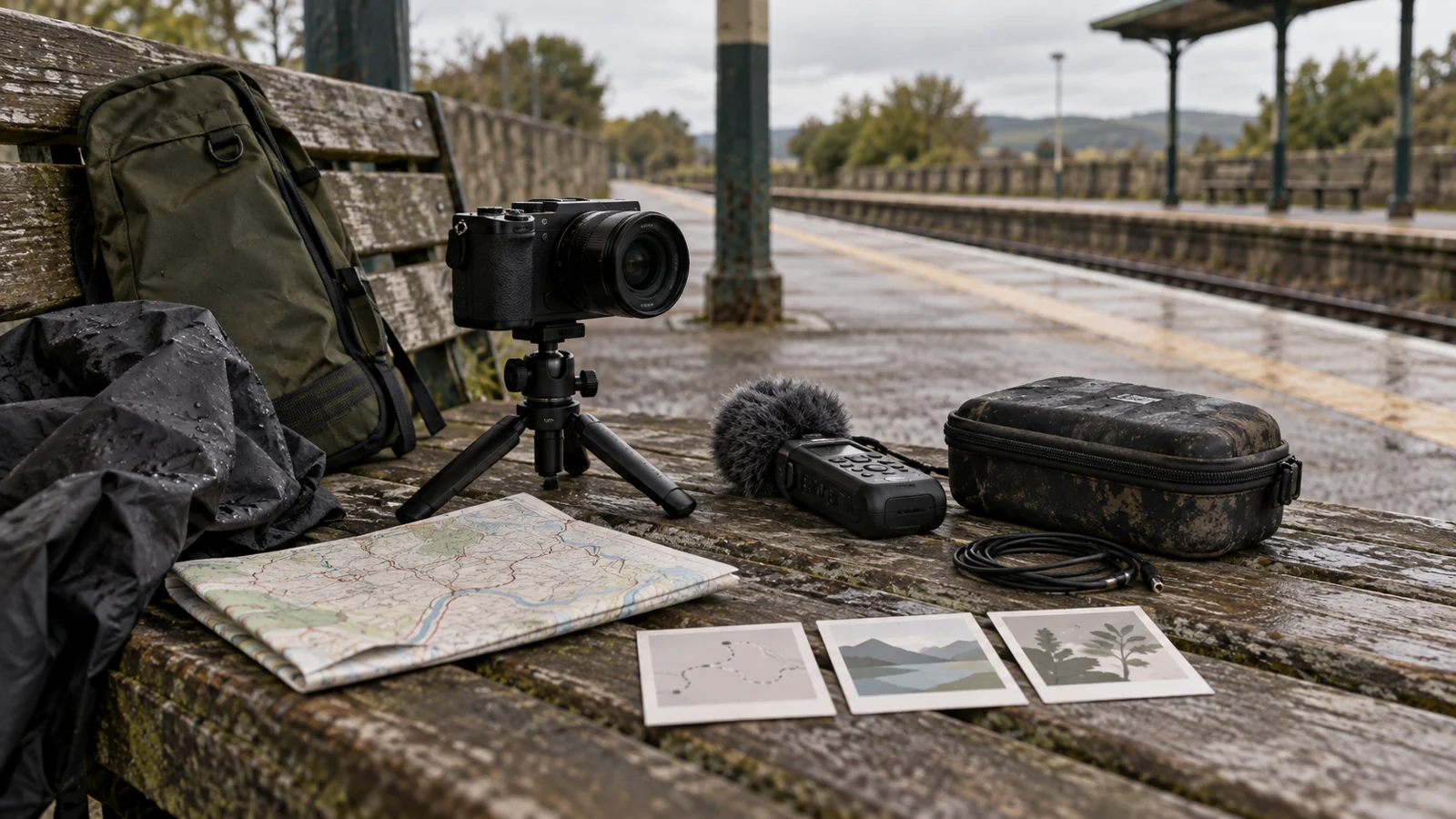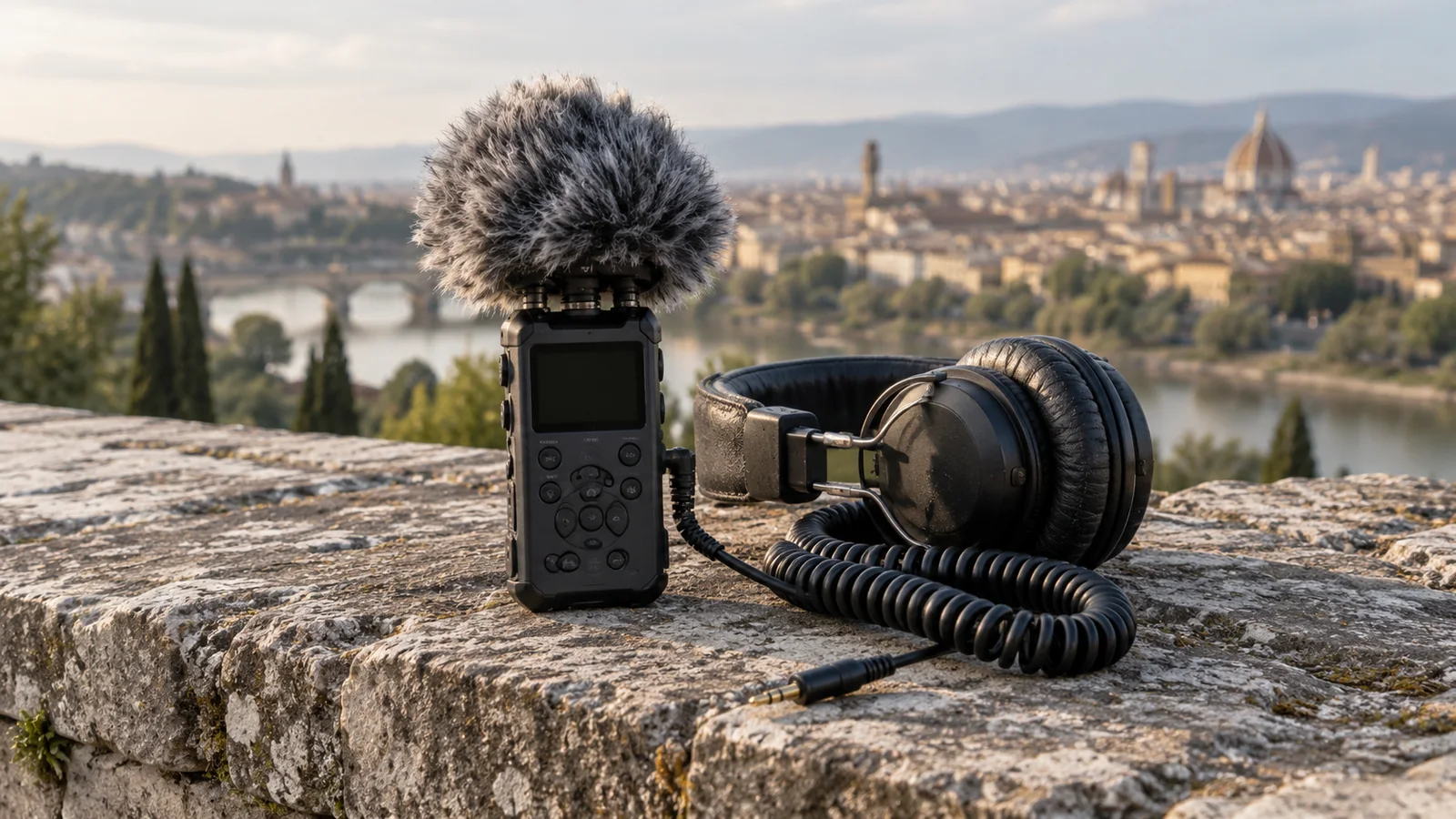
Good travel audio is usually won before the recording begins. A microphone closer to the speaker, a quieter position, a short test, and a separate ambience take can do more than aggressive cleanup after the trip. Noisy locations also create obligations: protect hearing, avoid blocking visitors, respect local rules, and obtain permission when a person’s voice is identifiable or the recording is part of a commercial production.
This guide is an on-location capture and repair decision system for creators recording streets, markets, stations, trails, museums, events, and interviews. It does not promise magic gear or noise removal without artefacts. The official sources cited here were checked on 2026-09-15; sound levels, permits, privacy rules, and venue policies remain location- and jurisdiction-dependent.
Start with the story and the risk
Write the audio job in one sentence: “The viewer must hear the guide’s explanation,” “the market ambience is the subject,” or “the sound of the train establishes place.” That sentence determines what to protect. If speech is the story, a beautiful ambience bed is secondary. If ambience is the story, do not erase every crowd sound simply because it is not clean.
List the consequences of failure. A missed quote may require a reshoot; a loudspeaker announcement may expose private information; a hidden child’s voice may create a consent problem; a dangerous position may put the crew or bystanders at risk. Decide in advance when to stop recording, move, ask permission, or use captions and narration later.
Choose position before processing
Distance is often the first signal-to-noise decision. Put the microphone as close to the intended speaker as the scene and consent allow. A closer source can improve the ratio between voice and background without asking a plug-in to remove the entire location. Keep the microphone aimed at the mouth or the useful sound source, not at the loudest visual landmark.
Move the people before reaching for a filter. Step away from a generator, speaker stack, extractor fan, or reflective wall. Use a doorway, vehicle side, hedge, or architectural barrier only when it is safe, permitted, and does not block access. Turn the speaker’s back toward a predictable noise source when that does not make the interaction unnatural. Record a few seconds in the new position and listen before committing to the take.
Use the smallest setup that achieves the story and can be monitored. A lavalier may keep speech close while a directional microphone can preserve a little more separation from the sides; neither is a guarantee in a reverberant crowd. Wind protection, secure cable routing, and a stable mount prevent handling and wind problems that no amount of dialogue enhancement can make invisible.
Record a test that represents the worst moment
Do not test only while the location is quiet. Ask the speaker to deliver the loudest line, turn toward and away from the microphone, and perform the movement that will happen in the shot. Wait for a bus, bell, crowd surge, or announcement if it is part of the expected scene. Monitor the input meter and listen on headphones. Keep input gain and headphone volume separate: turning headphones down does not create headroom.
Record the test and play it back. Check consonants, plosives, clothing rustle, wind bursts, cable bumps, radio dropouts, and the difference between the speaker’s close and distant positions. If the input clips, lower the preamp or change the source position before recording the real take. A limiter can protect a later mix; it cannot restore a microphone preamp or converter that overloaded.
Capture speech, ambience, and room tone as separate decisions
Record the interview or narration with the microphone position that protects intelligibility. Then capture a clean ambience take without talking over it. Include a short section of representative background noise for repair, but do not assume a few seconds can represent a changing crowd. Adobe Audition’s documentation recommends recording representative background noise for a noise print and distinguishes constant noise reduction from adaptive treatment for variable noise.
Capture a wild track of the place: footsteps, traffic wash, a market bed, a platform announcement, or a room impulse. Note the location, time, direction, unusual events, and whether identifiable people are present. This lets an editor rebuild continuity without looping the exact sentence containing a stranger’s voice.
If the scene contains a critical sound, record it closer or separately when possible. A distant shutter, bell, or vendor call may be useful as atmosphere but unusable as evidence. Record a clean version of the action and a wider ambience version; label both immediately.
Protect hearing and situational awareness
A noisy place is a hearing-safety problem before it is an audio-quality problem. NIOSH sets an occupational recommended exposure limit of 85 A-weighted decibels averaged over an eight-hour workday and notes that risk depends on loudness, duration, and repetition. NIOSH also cautions that this occupational limit is not a universal rule for every recreational environment. Use it as a safety reference, not as permission to stand beside a loud source.
If people must raise their voices at arm’s length, treat the environment as potentially hazardous and measure it with a suitable sound-level meter or screening tool. Reduce time near the source, move farther away, use hearing protection where appropriate, and preserve the ability to hear alarms, traffic, and instructions. Do not seal yourself into headphones at a level that hides the environment. A short take is not worth an injury.
Respect people, places, and permissions
Public visibility is not a universal permission to record or commercially publish an identifiable person’s voice. Ask the venue, event organiser, transport operator, property owner, or relevant authority about filming and audio rules. Obtain releases or clear on-camera consent when the speaker is a subject, contributor, employee, client, or featured member of the public. Avoid recording private conversations that are not part of the story.
The U.S. National Park Service explains that audio recording in park areas can be subject to conditions, fees, permits, and rules even after recent legal changes; it directs visitors to contact the specific park. Other countries and venues have different rules. Document who granted permission, what was allowed, where, when, and whether commercial use or later edits were included. If consent is unclear, change the composition, ask the person, remove the identifying material, or do not use the take.
Repair in the least destructive order
Keep the original file untouched and work on a copy. First trim unusable sections and choose the cleanest take. Then correct obvious gain, channel, sync, and phase problems. Address a narrow problem with a narrow tool: a high-pass or rumble reduction for low-frequency handling noise, a notch or de-hum for a stable electrical tone, and a click repair for a short transient. Broad noise reduction on a whole crowd recording can remove consonants and create watery or bubbly artefacts.
For constant noise, capture a representative noise print and reduce it conservatively. For changing traffic or wind, adaptive processing may help but can misread speech and ambience. Adobe’s guidance notes that the proper amount depends on the background and acceptable quality loss, and that stronger settings can introduce artefacts. Compare processed and unprocessed dialogue at matched level; louder is not proof of better.
Use spectral editing for an isolated horn, cough, or squeak only when the wanted voice is not occupying the same time-frequency region. If the noise overlaps the words, replace the sentence with a clean pickup, cut to b-roll, use a caption, or narrate later. De-reverb can reduce a room signature but cannot reliably recreate a close, dry recording from a distant microphone. Do not promise that AI enhancement will recover missing detail.
Make the result accessible and honest
Provide accurate captions for meaningful speech and identify important non-speech cues when they carry the story. Review automatic transcription carefully: names, places, numbers, negations, and local words are common failure points. If the environment defeats intelligibility, let the picture and captions carry the claim, or rewrite the narration rather than hiding the uncertainty under music.
Keep a natural-sound version and a dialogue-priority version when the edit has two legitimate goals. Let the audience hear the place in transitions, then lower it under speech. Do not describe a location as peaceful while the audible track is dominated by a siren unless the contrast is intentional and explained.
On-location and repair checklist
Before leaving a location, confirm:
- The recording job, safety boundary, and consent path are written down.
- The microphone is close, secure, wind-protected, and aimed at the intended source.
- A representative loud test was monitored and played back before the real take.
- Dialogue, ambience, room tone, and critical effects have identifiable files.
- Input gain, headphone level, channels, sample rate, and file names are recorded.
- Exposure time, hearing protection, traffic, alarms, and crew awareness remain safe.
- Permission, venue rules, releases, and commercial-use limits are documented.
- Repair starts from a copy, uses the narrowest effective process, and is compared at matched level.
- Captions and any editorial uncertainty are reviewed before publication.
If the speech is not recoverable, change the edit. Use a pickup, voiceover, caption, cutaway, or honest ambience-only moment. A clean replacement that is clearly labelled is more trustworthy than a heavily processed clip presented as original location sound.
Sources and scope
- CDC/NIOSH — Noise-Induced Hearing Loss — official exposure and hearing-safety guidance; accessed 2026-09-15.
- CDC/NIOSH — Understand Noise Exposure — official measurement and hazard indicators; accessed 2026-09-15.
- OSHA — Occupational Noise Exposure — official workplace controls and hearing-conservation guidance; accessed 2026-09-15.
- Adobe Audition — Applying noise reduction techniques and restoration effects — official noise-print, adaptive reduction, and restoration guidance; accessed 2026-09-15.
- Adobe Premiere — Repair dialogue — official dialogue-repair guidance and quality caveat; accessed 2026-09-15.
- National Park Service — Filming, Still Photography, and Audio Recording — official location, permit, and visitor-impact guidance; accessed 2026-09-15.
The capture workflow and editorial recommendations are Angry Media synthesis. Hearing limits are occupational references, not universal guarantees for travel or recreational settings. Recording permissions, privacy law, venue rules, restoration quality, and platform requirements vary by jurisdiction, location, equipment, and version. This article is educational, not legal or medical advice. Source review completed 2026-09-15; scheduled publication 2026-11-07.
Comparison Matrix