Automotive b-roll should make a vehicle’s story legible without turning the road into a stunt set. The strongest sequence moves from place and purpose to form, detail, interaction and motion. It also protects the driver, crew, public, vehicle and rights in the frame.
This shot list is built for parked and moving vehicles, from a short social profile to a longer review or brand film. It is a planning tool, not a driving manual. Do not instruct a driver to look at a camera, hold a device, exceed a limit, break a traffic rule or perform a maneuver that has not been risk-assessed and legally approved.
Build the story before the list
Write the vehicle’s editorial promise in one sentence: “This is a quiet electric commuter in a dense city,” “This is a restored touring car,” or “This is a work vehicle designed for a specific task.” Decide what the viewer needs to understand and what the film is allowed to claim. A beauty sequence should not imply tested performance; a product demonstration should not hide a limitation.
Divide coverage into four functions:
- Orientation: where the vehicle is and why it belongs there.
- Identity: silhouette, badge, trim, material, condition and distinctive design.
- Use: a person entering, loading, adjusting, driving or observing safely.
- Transition: arrival, departure, changing light, route or final parked state.
Plan a clean master shot, a safety fallback and the minimum details needed to connect the sequence. Mark each shot as essential or optional so a scene can finish safely if time, weather or traffic changes.
Safety brief before the camera rolls
Assign a producer or safety lead who can stop the shoot. The driver’s only job while moving is driving. Mount cameras before departure, keep crew out of traffic lanes, establish a communication method that does not require the driver to handle a phone, and use a spotter for any reversing or confined-area operation. Shoot moving coverage on a controlled, permitted location whenever possible.
NHTSA’s distracted-driving guidance, checked 2026-09-15, treats visual, manual and cognitive distraction as safety problems. Apply the simple production rule: the driver does not monitor framing, read directions from a camera operator, or respond to a creative cue while the vehicle is moving. Stop the vehicle before changing a camera, checking a take, adjusting a phone or discussing a retake.
Record location permissions, road restrictions, parking permissions, driver consent, passenger consent, model releases and any client requirements. Check local rules for filming in public space, mounted equipment, sound recording and identifiable bystanders. A public road is not automatically a controlled set.
Parked vehicle shot list
Capture the parked set first. It gives the editor coverage if moving shots are cancelled and creates a visual reference for color, condition and continuity.
Orientation and hero
- Establishing wide: vehicle in its environment, with enough negative space to understand the location.
- Three-quarter hero: front or rear three-quarter angle showing stance and major surfaces.
- Profile: full side view for silhouette, wheelbase and proportions.
- Rear three-quarter: lights, hatch, bed, diffuser or roofline.
- Static detail hold: a locked-off frame long enough for titles, narration or a clean edit point.
Keep the vehicle’s actual position and condition consistent between these views. Avoid a background that makes a parked car look like it is moving or a reflection that hides a dent the brief expects viewers to inspect.
Exterior construction
- Front identity: grille, lamp signature, intake or front badge.
- Lighting detail: headlamp or indicator turning on only when the vehicle is stationary and the action is safe.
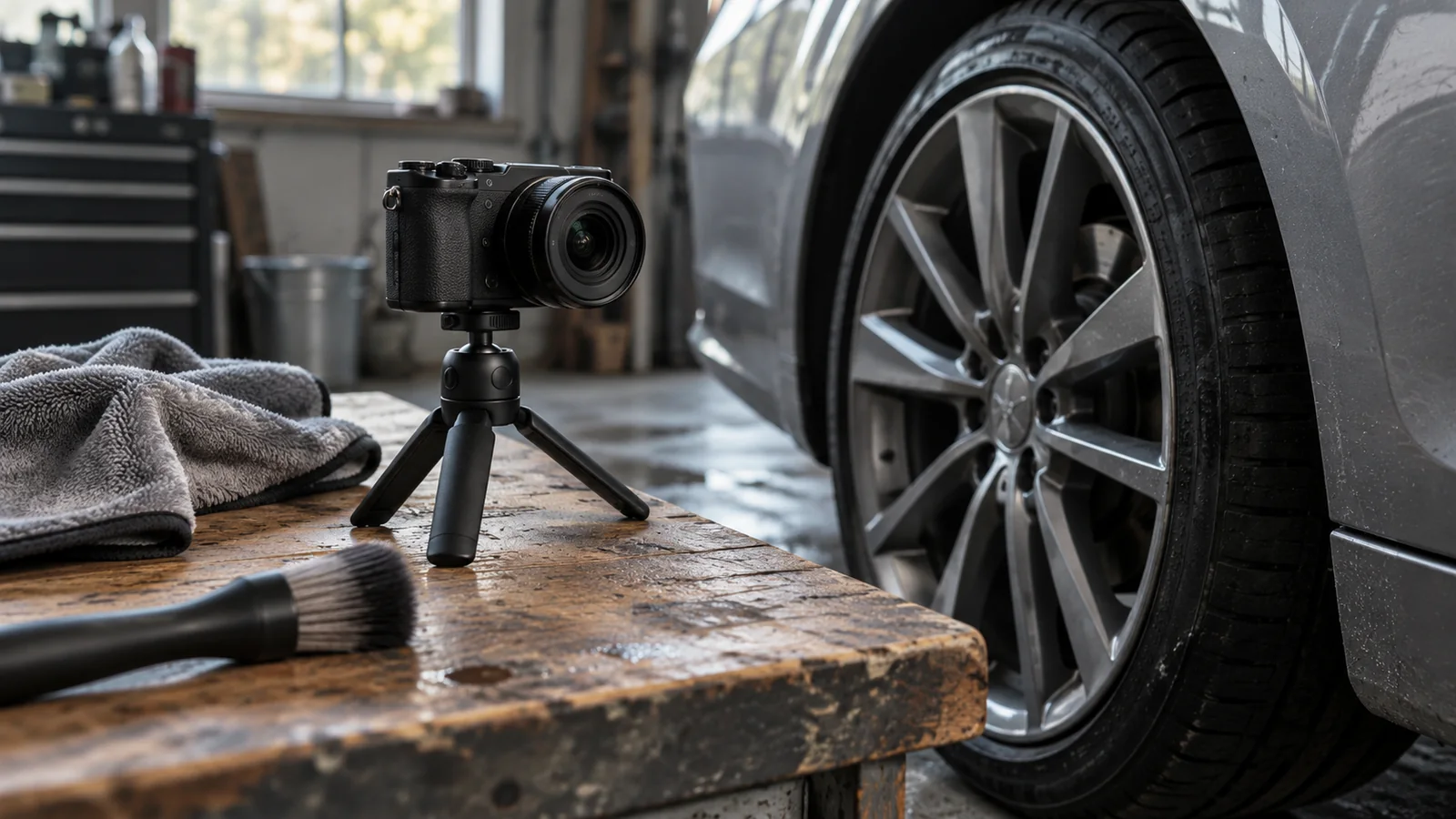
- Wheel and tire: tread, wheel design and brake detail where relevant; do not imply a safety or performance conclusion from appearance alone.
- Surface and finish: paint, wrap, panel gap, texture or weathering under controlled light.
- Functional touchpoint: door handle, charge port, fuel flap, tow point, roof rack or loading area.
Interior and interaction
- Cabin wide: dashboard, seating and visibility from a safe parked position.
- Material detail: stitching, fabric, trim, switchgear or wear.
- Interface detail: screen, instrument display or control, with personal data and navigation destinations cleared.
- Human scale: a consenting person enters or places an approved object inside while stationary.
- Use case: loading luggage, connecting a cable or preparing equipment; keep hands clear of moving mechanisms.
If the vehicle is supplied by a client, log pre-existing damage and dirt before styling. Do not polish away evidence in a condition review or use a prop that implies an included feature when it is not included.
Moving vehicle shot list
Moving shots should communicate travel, not daredevil behavior. Use a controlled route, a qualified driver, a legal camera mount or a separate camera vehicle operated by trained crew. No shot is worth improvising in live traffic.
Safe movement coverage
- Departure: vehicle begins from a legal stationary position; capture the transition without blocking a public path.
- Pass-by: camera remains in a safe, permitted position while the vehicle follows the approved route.
- Tracking: use a properly staffed and permitted camera vehicle or a stationary perspective; never ask a driver to match a camera cue.
- Rear follow or lead: only with a controlled operation, appropriate separation and a safety lead who can stop the take.
- Arrival: vehicle slows and parks legally, providing a narrative endpoint.
- Wheel and road detail: capture only from a secure, non-road position or with a pre-recorded controlled setup; do not place a person or camera in a vehicle’s path.
- Interior movement: camera is secured before motion, and the driver has no filming task beyond driving.
Capture clean passes in both directions if permitted, with consistent lighting and no pressure to repeat a risky take. Leave room to cut around traffic, pedestrians, signs and continuity changes.
Reflections, plates, brands and bystanders
Automotive surfaces mirror the world. Before each take, scan for crew reflections, production vehicles, house numbers, screens, personal documents and faces. A polarized filter or angle change may reduce glare, but no filter guarantees a clean reflection and no gear promise replaces a location check.
Treat license plates as potentially identifying information. Avoid framing plates when they are not needed, obscure them in post where appropriate, and check that a reflection or monitor does not reveal the same plate elsewhere. Do not publish a bystander’s face, voice, private property or conversation without the required consent or a lawful basis for the intended use.
Log manufacturer marks, dealer signs, third-party logos, music playing in the cabin and artwork visible in the location. A brand’s presence in a frame is not automatically an endorsement or permission to use the footage commercially. For paid work, the client should define whether incidental marks are acceptable and who clears them.
Drone and elevated shots
Drone footage adds orientation and scale, but it adds an aviation operation. Assign a remote pilot, visual observer and airspace/location check as required by the jurisdiction. In the United States, FAA Part 107 guidance checked 2026-09-15 says small UAS operations must avoid manned aircraft, remain within visual line of sight, avoid careless or reckless operation and follow restrictions on operating over people. Local rules, permissions and landowner requirements still apply.
Do not fly over moving traffic or uninvolved people as a creative shortcut. Establish a sterile area, a landing plan, a lost-link response and a weather stop. Put the drone shot on the call sheet as a separate operation, not an extra angle the camera team can improvise between takes.
Sound, music and accessibility
Record clean vehicle sound while stationary when possible: door latch, belt click, charge connection, indicator, cabin ambience and loading sounds. Keep microphones clear of controls, visibility and movement.
Music rights are separate from vehicle footage rights. Record the track, license, platforms, territory, term, paid-use permission and attribution. Do not assume music available in one social app clears a downloadable master or client ad.
Plan captions for dialogue and meaningful sounds. W3C’s current audio/video guidance, checked 2026-09-15, calls for captions, transcripts and visual descriptions according to what the audience needs. If the story depends on a silent dashboard display, hand signal or exterior detail, add spoken or text description so the meaning is not available only to a sighted viewer with sound.
Truthful claims and the edit
Keep a shot log with take, location, vehicle state, driver, camera position, movement status, permissions and notable reflections or plates. In the edit, preserve conditions around any claim: weather, route, load, software state, charging state and whether a maneuver was staged or static. FTC advertising guidance checked 2026-09-15 says advertising claims must be truthful, non-deceptive and evidence-based. B-roll should not be cut to imply a test that did not occur.
Review the cut for continuity: wheel direction, door state, light state, screen content, driver position, reflections and background traffic. Compare the final crop on mobile and desktop. If a detail is too compressed to verify, replace it or describe the limitation rather than sharpening it into false certainty.
Release gate
Before publishing, confirm:
- The shot list serves a written story and coverage purpose.
- Moving shots used a controlled, permitted operation with a driver focused on driving.
- Crew, passengers, pedestrians, roads and drone operations were risk-assessed.
- Plates, faces, private data, logos and reflections were cleared or obscured.
- Music, vehicle sound, locations, talent and brand uses have documented permissions.
- Claims match what the footage actually shows and conditions are not hidden.
- Captions, transcripts or descriptions cover the information needed to understand the sequence.
- A reviewer checked continuity, crop, audio, disclosure and platform rendering.
If safety, consent or rights are unresolved, use the parked fallback or remove the shot. A convincing automotive sequence is not the one with the most aggressive motion; it is the one that gives the viewer a coherent sense of vehicle, place and use while keeping every person and permission visible in the production record.
Sources and scope
- NHTSA — Distracted Driving — distraction and driver-safety guidance; accessed 2026-09-15.
- FAA — Small Unmanned Aircraft Systems (UAS) Regulations, Part 107 — commercial drone operating requirements and safety constraints; accessed 2026-09-15.
- W3C WAI — Making Audio and Video Media Accessible — captions, transcripts and visual description planning; accessed 2026-09-15.
- Federal Trade Commission — Advertising and Marketing — truthful, non-deceptive and evidence-based advertising claims; accessed 2026-09-15.
These sources support the safety, drone, accessibility and truthful-claim statements. The shot list, coverage logic and production checklist are Angry Media editorial synthesis. This article is educational, not legal, aviation, road-safety or insurance advice; verify local law, permits, location rules and qualified safety procedures before filming moving vehicles or drones. Source review completed 2026-09-15; scheduled publication 2026-11-13.
Quality Checklist