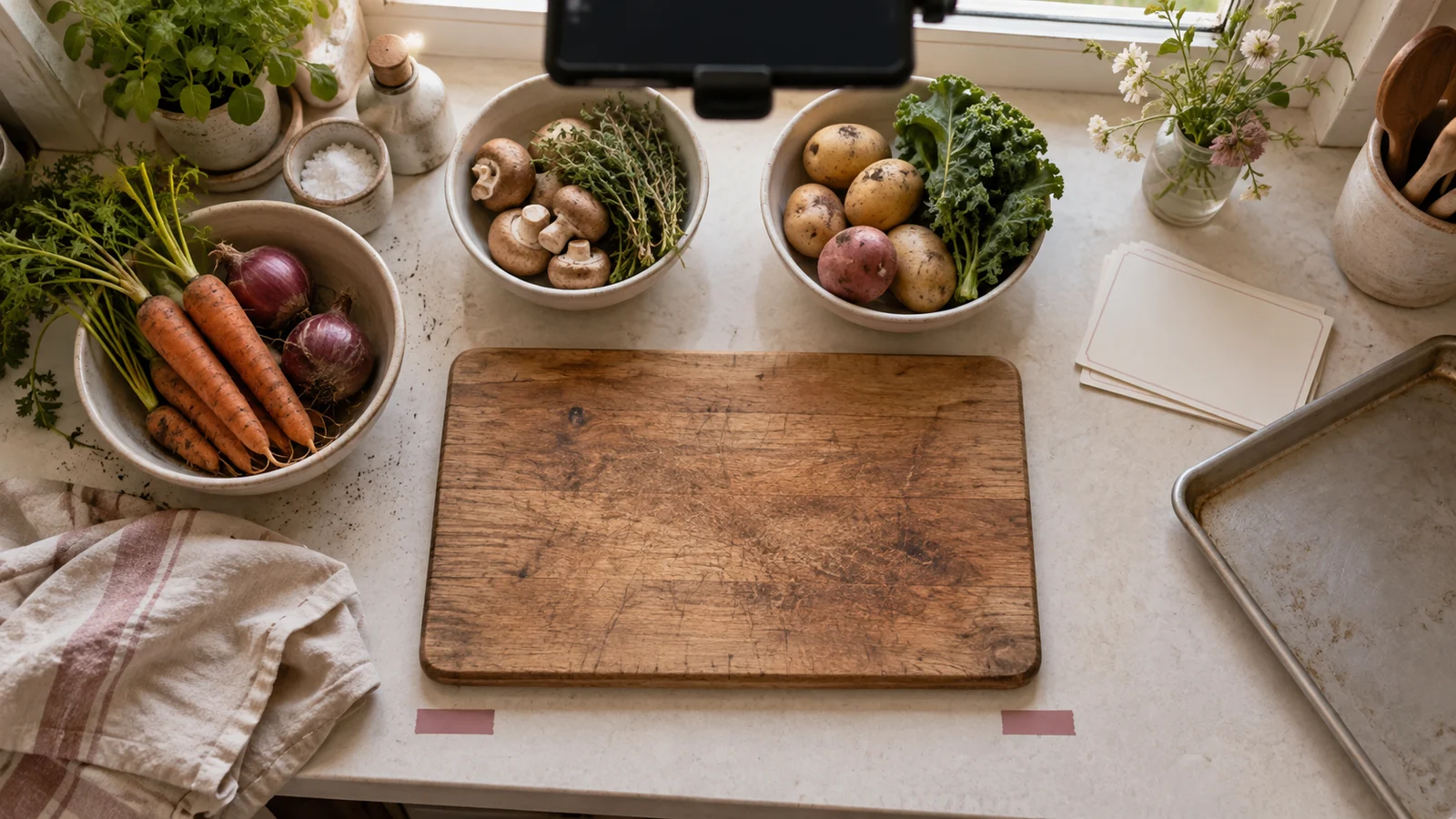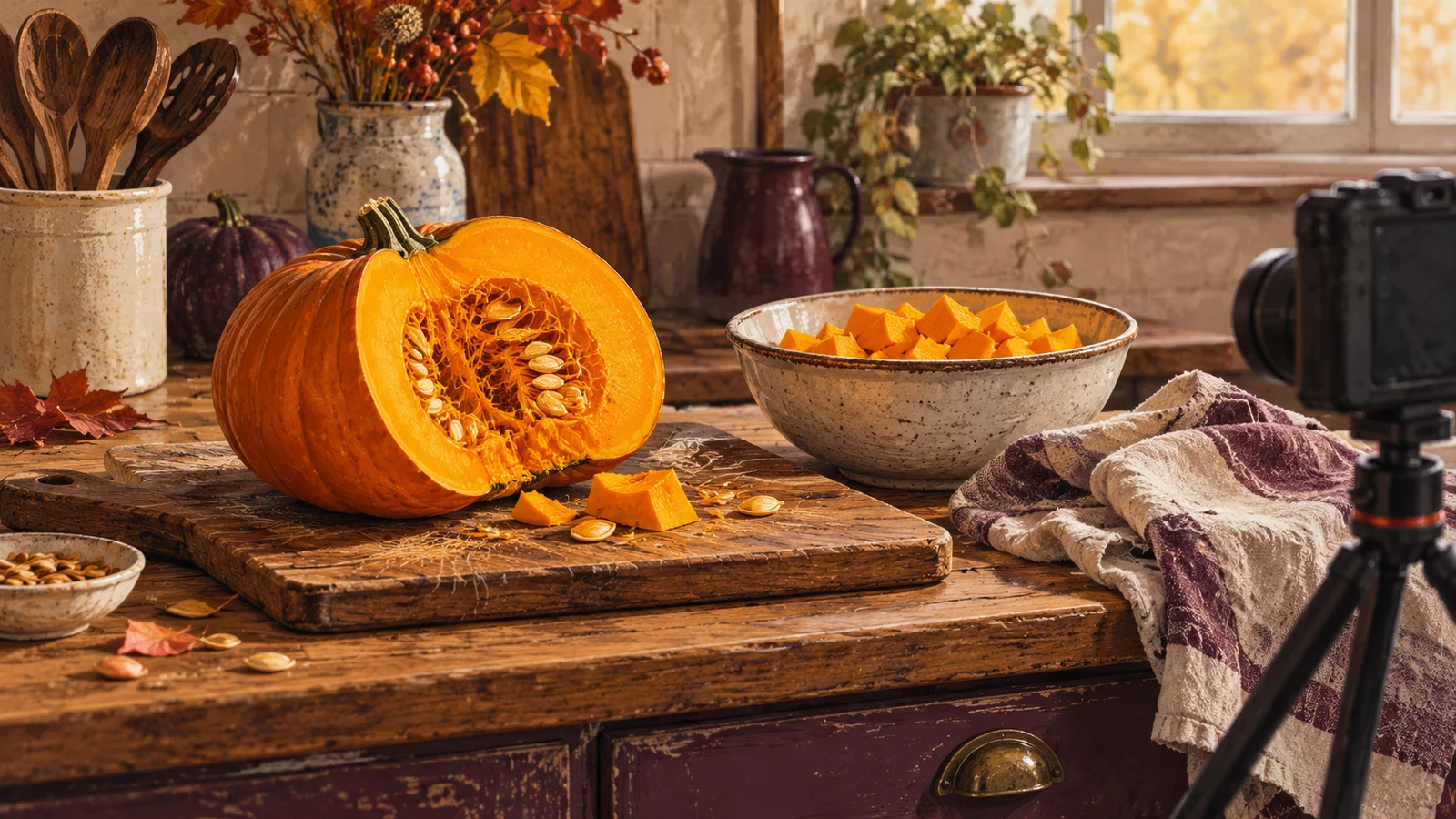
A useful Halloween recipe video shows how an ordinary preparation becomes a seasonal result. The decorative reveal draws attention, but the quantities, texture and sequence are what let viewers reproduce it. Treat the pumpkin shape, ghost icing or spiderweb pattern as the last part of a complete explanation.
Start with a recipe you have actually made. Film the successful process and keep notes on the real equipment, timing and changes. This article is a filming workflow, not a tested recipe or a substitute for the cooking instructions of the dish you choose.
Decide what the decoration teaches
Choose one observable transformation. A piping pattern on a baked biscuit, a face arranged on a prepared savory dish or a shaped garnish provides a clear before and after. Avoid combining several unfamiliar techniques when a short video can explain only one of them adequately.
Write the viewer promise: “See the icing consistency and the three lines that form the web,” rather than “Make the ultimate spooky treat.” The first promise tells you which closeups to capture. The second invites decorative footage without a clear lesson.
Show the finished food early, then return to the process. An opening glimpse can establish the outcome without requiring you to hide useful information until the final seconds. Include the full recipe in the accompanying page or caption when the video cannot hold all necessary detail.
Plan shots around irreversible steps
Mixing, baking, slicing and decorating cannot always be repeated cleanly for the camera. Prepare the tripod, framing and focus before the action starts. Use a spare sample for a framing rehearsal rather than repeatedly altering the actual batch.
| Step | Useful shot | Information to preserve |
|---|---|---|
| Ingredient preparation | Labeled overhead view | Real quantities and relevant substitutions |
| Mixing | Close view of the bowl | The texture before the next stage |
| Cooking | Oven or pan context without unsafe positioning | Actual temperature and time in the recipe |
| Cooling or setting | Before-and-after continuity | Waiting time that affects decoration |
| Halloween decoration | Stable closeup of hands | Order, tool angle and visible technique |
| Final result | Cut, break or serving detail | The texture viewers will actually get |
The footage can be filmed out of order, but the final explanation must present the real sequence. Keep a simple take log so an attractive shot of the wrong batch does not become an inaccurate demonstration.
Keep the food workflow in control
Prepare a clean place for the camera and a separate place for handling ingredients. If you touch the phone, return to appropriate hand hygiene before handling food. Keep camera supports and cables clear of hot surfaces and normal kitchen movement.
The FDA's flour guidance warns against tasting raw flour, dough or batter and recommends separating raw ingredients from ready-to-eat foods. Do not stage a raw-dough tasting shot for a playful Halloween reaction. Record a tasting only when the chosen food is ready to eat.
For time-sensitive ingredients, complete the necessary cooking, cooling and storage before spending extra time on beauty shots. Make a small filming portion if repeated closeups would delay serving the rest of the food. Use the appropriate food-safety guidance for the recipe rather than inventing a universal safe filming time.
Light texture rather than orange props
Place the main light so viewers can distinguish icing thickness, crumb and edges. A Halloween-colored background can set the season without turning the entire dish orange. Lock exposure where your camera allows it and check the light after moving a reflective bowl or white plate.
Capture a neutral view of the finished food before a stylized angle. If your edit includes a dramatic dark shot, make sure viewers also see the actual decoration clearly. An unreadable web pattern is not improved by more theatrical lighting.
Keep one closeup long enough to show the tool completing a meaningful movement. Speeding everything up can hide the consistency or timing that explains why the recipe works. Label condensed passages so viewers do not mistake an edit for real preparation time.
Use seasonal music under the explanation
Disclosure: STIS is operated by Angry Media, NicheFrame's publisher. The seasonal STIS album linked below is one possible seasonal music preview alongside other licensed tracks or the natural sounds of your kitchen. Choose a passage that leaves space for quantities and instructions; the recipe should remain understandable when music is removed.
Give useful sounds their own moments: a finished biscuit breaking or a spoon passing through the prepared filling can show texture. Avoid replacing those recordings with effects that make the food seem different from the real result.
Review as someone cooking for the first time
Read every quantity and timing against your notes. Check captions, especially fractions and temperature units. W3C's caption guidance explains why automatic text needs accuracy review; a wrong cooking instruction is more serious than an awkward seasonal phrase.
Watch without sound and ask whether the order remains clear. Then watch with sound and notice whether music masks a necessary instruction. Publish the actual tested recipe, identify meaningful changes and let the Halloween styling invite viewers into a process they can follow.
For the underlying filming sequence beyond Halloween, see recipe steps viewers can follow.